

CASE STUDY: MERCURY THEATRE, COLCHESTER
 CREDIT: XAV MARSEILLE
SHAPING NATIONAL POLICY AND SECURING CULTURE'S PLACEIN ENGLISH DEVOLUTION
IN SUMMARY
From sector insight to legislative change, MPC helped Mercury Theatre catalyse national debate, influence Parliament and secure recognition for culture within England’s devolution framework.
SHORT VERSION
MPC was asked by Mercury Theatre in Colchester to make sure arts and culture were included in the UK Government's English devolution legislation. Facing the risk that cultural organisations would be locked out of new governance structures for years, MPC helped Mercury build a policy-aligned narrative, engage ministers and peers in Parliament, and speak to the media, including placing a well-timed opinion piece in Arts Professional that sparked wider political attention. Along with other advocates and activists in this space, Mercury’s campaign led to a parliamentary amendment to the English Devolution and Community Empowerment Bill recognising culture within the devolution framework, with Mercury's CEO Steve Mannix cited in a House of Lords debate, and further establishing the theatre as a credible national voice on culture and regional growth.
THE CHALLENGE
The UK Government’s plans for English devolution represented a profound shift in how major regions would be governed, funded and prioritised.
For cultural organisations, the risk was clear. Arts and culture were not explicitly included in the draft legislation or emerging combined authority frameworks, leaving them vulnerable to exclusion from decision-making for a decade or more.
For Mercury Theatre, a major regional producing theatre with deep local impact, this posed both a threat and an opportunity:
Risk of reduced funding and influence in new governance structures
•
Lack of recognition of culture’s economic and social value
•
A critical window to shape policy before frameworks were fixed
MPC was engaged to help Mercury navigate this moment of structural change and influence the outcome.
OUR APPROACH
We positioned Mercury as a cultural beacon for the region, as well as – crucially - an authoritative national voice on culture, place and regional growth.
Our work combined strategic communications, public affairs and profile-building:
1. Strategic narrative
Developed a clear, evidence-based narrative around Mercury’s economic, social and community impact, created through a senior leadership all-day workshop
•
Framed culture as essential infrastructure for growth, skills and place-making
•
Aligned messaging to the priorities of policymakers – jobs, productivity, skills and regeneration
2. Public affairs and political engagement
Built relationships with ministers, officials and peers across the House of Lords and across Essex
•
Secured face-to-face engagement with the Department for Housing Communities, and Local Government (MHCLG), including the Devolution Minister, Miatta Fahnbulleh MP
•
Helped shape and support amendments to the Devolution Bill through direct parliamentary engagement
3. Media and thought leadership (catalyst for influence)
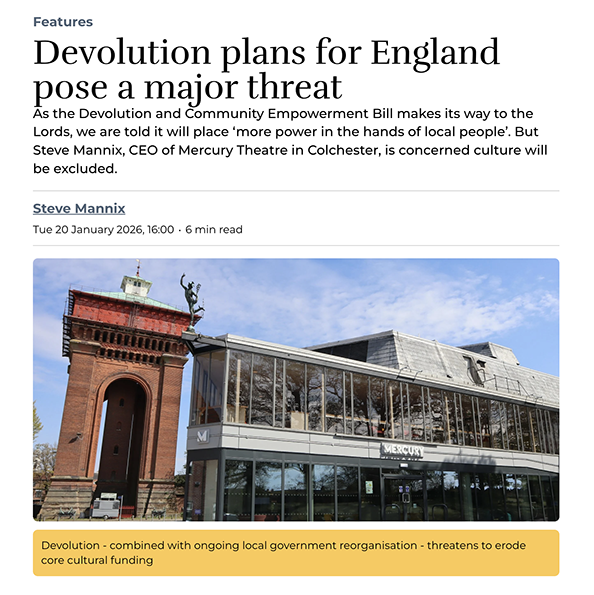
Placed a strategically timed opinion piece in Arts Professional setting out the risks devolution posed to the cultural sector
•
Framed the issue in policy-relevant terms – funding risk, non-statutory status and long-term structural impact
•
Coverage ensured the argument reached both sector leaders and policymakers at a critical moment in the Bill’s progress
•
Used this intervention to trigger wider media, political and stakeholder engagement
4. Stakeholder influence
Engaged sector bodies including SOLT and UK Theatre
•
Built cross-party relationships to ensure broad political support
•
Activated local and regional stakeholders to reinforce the message.
WHAT WE ACHIEVED
The work delivered tangible impact at local, sector and national level:
Catalysed national attention and political engagement
The Arts Professional article became a key intervention point in the campaign – picked up by sector leaders, and read by peers in the House of Lords, including Earl Clancarty. It helped bring the issue into sharp political focus and galvanised parliamentary attention.
Direct political and stakeholder response
The piece prompted regional political leaders to contact Mercury directly to acknowledge and thank them for raising the issue.
Influence on legislation
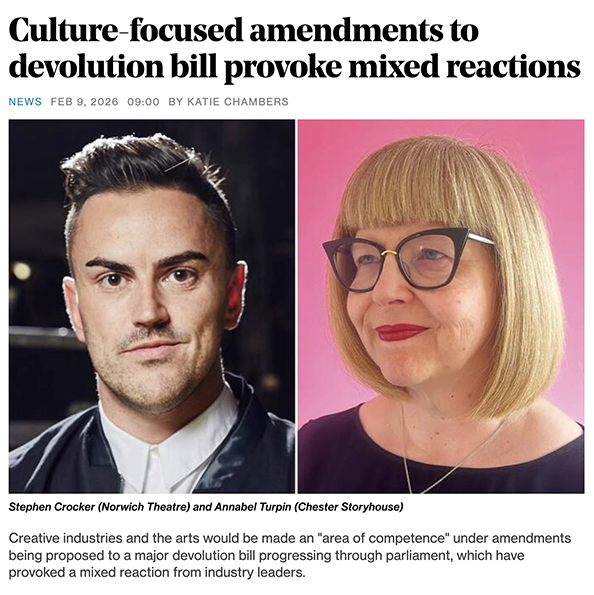
Momentum generated through media, sector and parliamentary engagement contributed to an amendment being agreed to ensure culture is recognised within the devolution framework.
Parliamentary recognition
Mercury Theatre and CEO Steve Mannix were referenced in a House of Lords debate, with arguments from the campaign reflected in discussion.
National media impact
Thought leadership translated into wider coverage and sector visibility, strengthening Mercury’s position within the national conversation.
Leadership positioning
Mercury and the CEO, Steve Mannix, were further established as a credible and influential voice in national policy discussions on culture and devolution.
THE OUTCOME
MPC helped Mercury actively shape the national policy environment agenda.
At a critical moment in the legislative process, Mercury combined strategic communications, political engagement and thought leadership to help move culture from the margins of the devolution debate into the legislative framework itself.
MERCURY
Influenced national policy
•
Strengthened its political relationships
•
Raised its profile across government, media and the sector
•
Secured greater recognition of culture within future devolved structures
SIGNIFICANCE
Devolution will shape local priorities and investment for decades.
By intervening early and strategically, Mercury helped ensure that arts and culture are part of that future – not left out of it.
MPC’S ROLE
This project exemplifies MPC’s approach:
Strategic advice for cultural and creative leaders navigating funding, influence and growth
We combine:
Strategic communications
•
Public affairs and advocacy
•
Leadership positioning
… to help organisations not just respond to change, but shape it.
Miatta Fahnbulleh MP, Devolution Minister said:
“It’s been great to work together and I’m really pleased we got the inclusion of culture through. Lots to build on.”
Steve Mannix, CEO, Mercury Theatre Colchester said:
“MPC played a critical role in helping us navigate a moment of real structural change. Their ability to translate complex policy into a clear, compelling narrative – and then ensure that narrative landed with the right people – was hugely impressive.
The Arts Professional piece they developed with us proved to be a genuine catalyst, driving national attention, influencing parliamentary debate and ultimately contributing to a tangible shift in the legislation.
They don’t just advise – they help you shape the environment you’re operating in.”
